The short answer
Archetypes are everywhere once you look: the wise mentor, the reluctant hero, the trickster who breaks the rules, the caring mother figure. They appear in ancient myths, fairy tales, novels, films and advertising. Most people meet the idea through a quiz that tells them they are "a Sage" or "an Explorer".
That quiz version and the original psychological idea are quite different, and it helps to know which one you are dealing with. This guide explains what Carl Jung meant by archetypes, where the popular list of 12 comes from, how the persona and shadow fit in, and how much weight the idea can carry.
What an archetype is
In everyday language, an archetype is a typical example or original model of something: the archetypal small-town diner, the archetypal rebel. In psychology and storytelling, it means a recurring pattern of character, situation or image that people across cultures recognize without being taught.
The Swiss psychiatrist Carl Gustav Jung gave the word its psychological meaning. In the essays collected in The Archetypes and the Collective Unconscious (volume 9, part 1 of his Collected Works), he proposed that beneath each person's individual unconscious lies a deeper layer shared by all humans, which he called the collective unconscious. Archetypes were its contents.
Form without content
Jung was careful to say that an archetype is not an inherited picture or idea. It is closer to an inherited tendency to form certain kinds of images, an empty form that each life fills in. We do not inherit an image of our mother. In Jung's view, we inherit a readiness to experience someone as "mother", and our actual experiences give that readiness its particular shape and emotional charge.
What we can observe are archetypal images: the specific figures that appear in a culture's myths or a person's dreams. Jung wrote about many, including:
- The Mother: nurture, but also smothering or devouring.
- The Child: new beginnings, vulnerability and potential.
- The Trickster: the rule-breaker who causes chaos and change.
- The Wise Old Man: guidance and meaning, often appearing at a crisis.
- The Anima and Animus: the inner image of the other sex (a part of Jung's theory that many modern readers find dated).
- The Self: the archetype of wholeness, which Jung saw as the goal of development.
Persona and shadow
Two of Jung's ideas have travelled furthest outside his own writing, and they are the most practical.
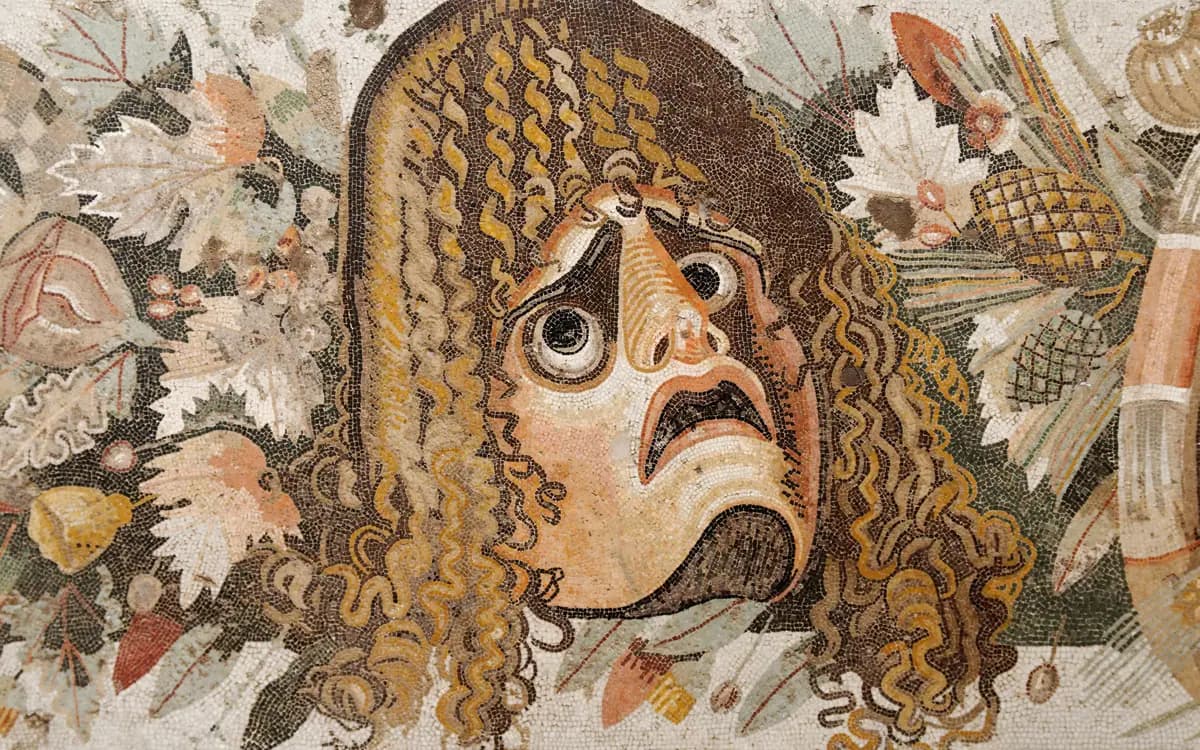
The persona is the mask you wear for the world: the professional manner at work, the cheerful face at a party. The word comes from the Latin for an actor's mask. Jung did not see it as fake. It is necessary. Problems start when you identify with it so completely that you forget there is anything else.
The shadow holds the parts of yourself you do not acknowledge: traits you were taught were unacceptable, such as anger, envy, ambition or neediness. Because you do not see them in yourself, you tend to spot them, often with strong feeling, in other people. Jungians call this projection. A useful question that comes from this idea is: when someone irritates me out of all proportion, what are they doing that I do not let myself do?
We go deeper on both in persona and shadow explained.
The 12 archetypes (and where they come from)
The familiar list of 12 archetypes (Innocent, Everyman, Hero, Caregiver and so on) is not Jung's. Jung never produced a fixed list. The 12 come mainly from Carol S. Pearson's work on personal development, especially Awakening the Heroes Within (1991), and in their best-known form from The Hero and the Outlaw (2001), a marketing book by Margaret Mark and Carol Pearson about building brands around archetypal stories.
That origin matters. The 12 archetypes were designed to help brands tell consistent stories, which is why so many explainers pair them with company logos. They are a useful vocabulary for characters and motivations. They were not developed or tested as a personality measure.
Mark and Pearson grouped the 12 by the basic human motivation each one serves.
| Archetype | Core desire | Core fear | Shadow side |
|---|---|---|---|
| Innocent | Safety and happiness | Doing wrong, being punished | Naivety, denial |
| Explorer | Freedom and discovery | Being trapped, conformity | Aimless wandering, never committing |
| Sage | Truth and understanding | Being deceived, ignorance | Detached overthinking, dogmatism |
| Hero | Proving worth through mastery | Weakness, vulnerability | Arrogance, needing an enemy |
| Outlaw (Rebel) | Overturning what does not work | Powerlessness | Destruction for its own sake |
| Magician | Making things happen, transformation | Unintended consequences | Manipulation |
| Everyman (Regular Guy or Gal) | Belonging | Being left out | Losing yourself to fit in |
| Lover | Intimacy and connection | Being unloved, alone | Obsession, jealousy |
| Jester | Joy and living in the moment | Boredom | Deflecting with jokes, irresponsibility |
| Caregiver | Protecting and helping others | Selfishness, ingratitude | Martyrdom, control through helping |
| Creator | Making something of lasting value | A mediocre vision | Perfectionism |
| Ruler | Order and control | Chaos, being overthrown | Tyranny, rigidity |
Motivation groups, following Mark and Pearson: Innocent, Explorer and Sage seek independence and fulfillment; Hero, Outlaw and Magician seek mastery; Everyman, Lover and Jester seek belonging; Caregiver, Creator and Ruler seek stability and control. Note that the "shadow side" column is interpretive. Different authors describe each archetype's darker form a little differently.
For a deep dive into one of them, read the Ruler archetype explained.
Are archetypes scientific?
Honestly, not in the way personality traits are.
Jung's claim that archetypes are inherited through a collective unconscious has not been supported in a testable form, and modern psychology does not use it as a working theory. The recurring characters in myths can be explained in other ways too: humans share similar bodies, families, fears and social lives, so similar stories keep emerging.
Archetype quizzes have a further problem. Their descriptions are usually broad and flattering, which makes them feel accurate to almost anyone. In 1949, Bertram Forer gave students what they thought were personal personality readings. Everyone got the same text, and on average they rated it as a very good description of themselves. This is now called the Barnum or Forer effect, and it is the main reason a result that "feels exactly like me" is weak evidence.
How this compares with the Big Five
The Big Five traits (openness, conscientiousness, extraversion, agreeableness and emotional stability) were built the other way round. Researchers started from data, measured traits on continuous scales, checked that scores were consistent over time, and tested whether they predicted real outcomes. A 2007 review by Brent Roberts and colleagues found Big Five traits predicted mortality, divorce and occupational attainment about as well as socioeconomic status and cognitive ability did.
Even the Myers-Briggs Type Indicator, which descends from Jung's separate theory of psychological types, has been reinterpreted in Big Five terms: McCrae and Costa showed in 1989 that four of its scales line up with four of the Big Five dimensions.
| Archetypes | Big Five traits | |
|---|---|---|
| Origin | Jung's clinical theory; myth and literature; branding | Statistical analysis of how people describe each other |
| Format | Types or characters | Scores on continuous scales |
| Main use | Reflection, storytelling, branding | Research and prediction |
| Evidence as a measure | Weak | Strong and replicated |
If you want a measured profile, use a trait-based tool such as our personality test. If you want a vocabulary for the stories you tell about yourself, archetypes can be a rich one. For a lighter take on types, see our animal personality archetypes.
Using archetypes as a reflection tool
Treated as a lens rather than a diagnosis, archetypes can prompt useful questions. These draw on Jungian ideas without claiming to type you.
- What story are you telling? If the last five years were a book chapter, what would its title be: a struggle, an adventure, a rescue, a building project?
- Where does your energy come from? Notice when you feel most alive (achieving, learning, connecting, creating) and when you feel drained.
- Who irritates you, and who do you envy? Strong reactions can point to qualities you have pushed into the shadow.
- Which fear grips you most? Being weak, trapped, ordinary, alone, out of control or fooled? The table above links each to an archetype.
- Is this who you are, or who you want to be? It is easy to pick the flattering archetype. Check it against what you actually do.
- What is the shadow of your favorite? If you only recognize the bright side of your archetype, you are probably describing your persona.
Mistakes to avoid
- Treating a type as fixed. Different situations and life stages bring out different patterns.
- Inflation. Over-identifying with one archetype, such as the Healer who cannot admit mistakes.
- Using the shadow as an excuse. "That's just my shadow" can become a way to avoid changing behavior.
- Taking quiz results as measurement. They are prompts for reflection, not scores.
Questions people ask
What are the 12 Jungian archetypes?
Jung never listed 12. The popular set (Innocent, Everyman, Hero, Caregiver, Explorer, Outlaw, Lover, Creator, Jester, Sage, Magician and Ruler) comes from Carol Pearson's work and the 2001 branding book The Hero and the Outlaw by Margaret Mark and Carol Pearson. It draws loosely on Jung's ideas.
What is the difference between an archetype and a stereotype?
A stereotype is a simplified, often negative, label applied to a group of people. An archetype is a recurring pattern in stories and imagination, usually with both a positive and a shadow side.
Can your archetype change?
In the frameworks that use them, yes. Different archetypes are said to come forward in different roles and stages of life. Because there is no validated measure, it is best to treat this as a way of reflecting on change rather than a finding.
Are archetypes real?
As recurring patterns in myths and stories, yes, they are easy to observe. As inherited structures in a collective unconscious, as Jung proposed, there is no strong scientific evidence.
Is an archetype test the same as a personality test?
No. Archetype quizzes sort you into characters for reflection. Trait-based personality tests, such as Big Five measures, score you on dimensions that have been tested for consistency and for how well they predict real outcomes.
References
- 1.Jung, C. G. (1959, 2nd ed. 1968). The Archetypes and the Collective Unconscious. Collected Works of C. G. Jung, Vol. 9, Part 1. Princeton University Press.
- 2.Mark, M., & Pearson, C. S. (2001). The Hero and the Outlaw: Building Extraordinary Brands Through the Power of Archetypes. McGraw-Hill.
- 3.Pearson, C. S. (1991). Awakening the Heroes Within: Twelve Archetypes to Help Us Find Ourselves and Transform Our World. HarperSanFrancisco.
- 4.McCrae, R. R., & Costa, P. T. (1989). Reinterpreting the Myers-Briggs Type Indicator from the perspective of the five-factor model of personality. Journal of Personality, 57(1), 17-40.
- 5.Roberts, B. W., Kuncel, N. R., Shiner, R., Caspi, A., & Goldberg, L. R. (2007). The power of personality: The comparative validity of personality traits, socioeconomic status, and cognitive ability for predicting important life outcomes. Perspectives on Psychological Science, 2(4), 313-345.
- 6.Forer, B. R. (1949). The fallacy of personal validation: A classroom demonstration of gullibility. Journal of Abnormal and Social Psychology, 44(1), 118-123.
Also relevant: Personality Test (30 questions · about 7 min).