Ada Lovelace IQ
Ada Lovelace's IQ is estimated at 135 to 155. She was never tested; the estimate rests on her 1843 Notes, which include the first published computer program.
Ada Lovelace's IQ is 145. What's yours?
25 questions · about 12 minutes
Think you're smarter than Ada Lovelace? Try question 1.
Which option completes the grid? One tap, no sign-up.
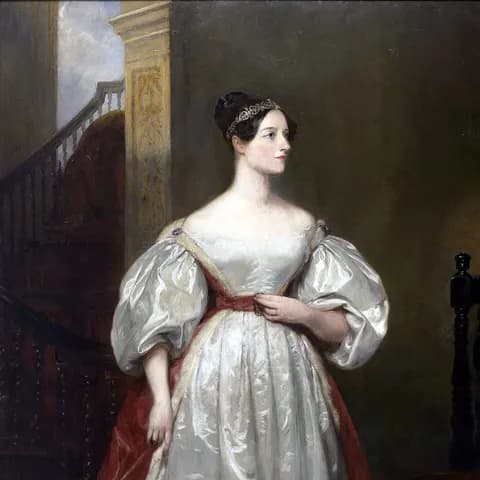
Key facts
- Estimated IQ
- IQ 145
- Known for
- First published computer program
- Lived
- Mathematician (Early Computing), 1815–1852
- Basis
- Documented writing (1843 Notes); no test
- Confidence
- Low. Ada Lovelace died in 1852. No IQ test result exists.
Lovelace's 1843 Notes show original thinking about what computers could do. 145 is an estimate based on that record, not a score.
What was Ada Lovelace's IQ?
Lovelace never took an IQ test, and no historiometric study rates her. LifeScore uses 145 as an estimate, with a range of 135 to 155, based on her 1843 Notes on the Analytical Engine, which contain what is often called the first published computer program.
What did Ada Lovelace invent?
She did not invent a machine. Charles Babbage designed the Analytical Engine. Lovelace translated a paper about it and added her own Notes, including a step-by-step method for computing Bernoulli numbers and the idea that such a machine could process music or symbols, not just numbers.
How smart was Ada Lovelace?
- 01
Note G
Her table of steps for computing Bernoulli numbers is often called the first published program. - 02
Beyond numbers
She wrote that the engine might compose music if the rules of harmony were expressed in its notation. - 03
Notes longer than the paper
Her Notes on Menabrea's article ran to about three times the length of the original. - 04
Serious mathematics
She studied calculus by correspondence with Augustus De Morgan.
How Ada Lovelace thought
Lovelace called her approach 'poetical science': using imagination to see what a machine might do, then working through the details. She saw that a machine that manipulates numbers could manipulate anything numbers can stand for.
The evidence behind the estimate
An estimate built from the historical record, not a recovered test score.
What supports it
- Her Note G set out a step-by-step method for the Analytical Engine to calculate Bernoulli numbers, often called the first published computer program.
- She argued the engine could work on symbols other than numbers, such as music, a leap beyond Babbage's own framing.
- She studied advanced mathematics by correspondence with Augustus De Morgan.
What it cannot prove
- Historians still debate how much of the mathematics in the Notes was hers and how much was Babbage's.
- Her output was small because she died at 36.
- No psychometric record exists.
Ada Lovelace compared with Turing, Noether, Marie Curie
| Figure | Estimate | Range |
|---|---|---|
| Ada Lovelace | 145 | 135–155 |
| Alan Turing | 170+ | 155–180 |
| Emmy Noether | 170+ | 155–180 |
| Marie Curie | 150 | 140–160 |
Psychological profile
Ada Lovelace's IQ is represented here by a retrospective estimate of 145, not a verified test result. Ada Lovelace is best known for exceptional systems thinking. The useful question is what the surviving evidence shows, not whether a precise modern score can be recovered.
High openness and symbolic reasoning. Saw systems as executable abstractions: imagination fused with mathematics.
The dominant archetype here is The Visionary. This archetype shapes decision patterns: what feels natural, what creates friction, and what blind spots tend to emerge.
Estimated IQ is 145. This is a rough estimate based on documented accomplishments and contemporary accounts, not a literal measurement.
Key traits
Systems Thinking
Ada displayed notable systems thinking, a trait that shaped their approach to challenges and opportunities.Imagination
Ada displayed notable imagination, a trait that shaped their approach to challenges and opportunities.Abstraction
Ada displayed notable abstraction, a trait that shaped their approach to challenges and opportunities.
One thing most people do not know
The programming language Ada, developed for the US Department of Defense, is named after her.
A modern parallel
If Ada Lovelace were alive today, a modern parallel in operating style might be Fei-Fei Li. The comparison is about working style, strengths and blind spots, not accomplishment level or IQ.
Ada Lovelace: common questions
Was Ada Lovelace a genius?
What personality type was Ada Lovelace?
Who is the modern equivalent of Ada Lovelace?
What can we learn from Ada Lovelace?
People with similar IQ estimates
Ada Lovelace's estimate of 145 falls in the genius level IQ range. See what an IQ of 145 means, place it on the IQ chart or check how rare it is with the IQ rarity calculator.
 Hypatia's IQMathematician & Philosopher, estimated 145+145+
 Napoleon Bonaparte's IQEmperor of the French, estimated 145145
 Thomas Edison's IQInventor & Businessman, estimated 145145
- Warren Buffett's IQInvestor, estimated 145+145+
 Marcus Aurelius' IQRoman Emperor & Philosopher, estimated 145+145+
Head-to-head
- Napoleon Bonaparte vs Ada LovelaceSide-by-side IQ estimates and evidence
Keep exploring
- Quick Pattern RecognitionSign of high intelligence
- Efficient Information ProcessingSign of high intelligence
- Dexter (Dexter's Laboratory)'s IQDexter's Laboratory, fan estimate 145
- Doctor Strange's IQMarvel Cinematic Universe, fan estimate 145
People also search for
All 157 historical IQ estimates, ranked with ranges and sources.
Ada Lovelace's IQ is 145. What's yours?
Ada Lovelace's estimate comes from the historical record. Yours can come from a real test: 25 visual reasoning questions.
25 questions · about 12 minutes
Sources
- Sketch of the Analytical Engine, with notes by the translator, Fourmilab (full text). Menabrea's paper with Lovelace's Notes A to G, including the Bernoulli number table.
- Ada Lovelace, Encyclopaedia Britannica. Biography covering her education and work with Charles Babbage.
- Cox, C. M. (1926). The Early Mental Traits of Three Hundred Geniuses. Stanford University Press.
- Simonton, D. K. (2009). Genius 101. Springer.
- Cattell, R. B. (1971). Abilities: Their Structure, Growth, and Action. Houghton Mifflin.
- Portrait: Margaret Sarah Carpenter · Public domain · Wikimedia Commons
Last reviewed September 2026. How we estimate historical IQ