Leonardo da Vinci IQ
Leonardo da Vinci's IQ is estimated at 160 to 180. The 180 comes from Catharine Cox's 1926 study; the 200 to 220 figures online have no documented source.
da Vinci's IQ is 160+. What's yours?
25 questions · about 12 minutes
Think you're smarter than Leonardo da Vinci? Try question 1.
Which option completes the grid? One tap, no sign-up.
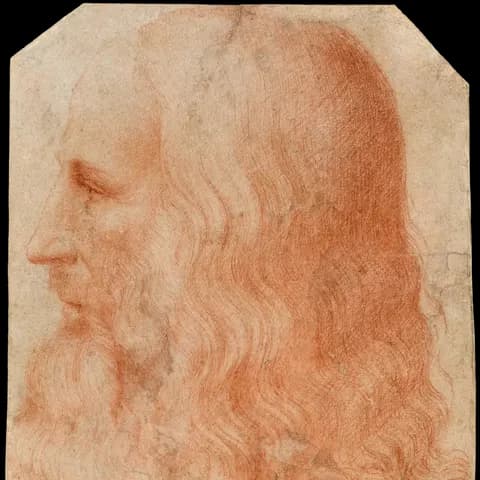
Key facts
- Estimated IQ
- IQ 160+
- Known for
- Mona Lisa, notebooks, anatomy
- Lived
- Polymath, 1452–1519
- Basis
- Cox 1926 historiometric estimate
- Confidence
- Low. Leonardo died in 1519. No IQ test was ever given, and no score exists.
Leonardo's notebooks show extraordinary range. Cox's corrected estimate is about 180; the 200 to 220 figures online have no documented method behind them.
What was Leonardo da Vinci's IQ?
Leonardo was never tested; he died in 1519. Catharine Cox's 1926 study rated him about 135 as a child and 150 as a young man, with a corrected estimate near 180. Allowing for the Flynn effect, LifeScore uses 160 to 180. Higher internet figures have no method.
Da Vinci vs Einstein: who was smarter?
No test can decide it. Cox rated Leonardo near 180 on her old scale but never covered Einstein. Einstein's genius was deep and focused on physics; Leonardo's was broad, spanning art, anatomy, engineering and optics. They are the classic examples of depth versus range.
Where do the 180 to 220 estimates come from?
The 180 has a real source. It is close to the corrected estimate Catharine Cox gave Leonardo in her 1926 study, built from records of his early life. Her raw figures were about 135 for childhood and 150 for ages 17 to 26.
The 200 and 220 figures are different. They appear on internet lists that cite no study, test or method, and seem to have grown by rounding up a reputation.
Cox's scale also runs higher than modern IQ. Adjusted for the Flynn effect, 180 falls to about 158, which is why LifeScore lists 160+ with a range of 160 to 180.
How smart was Leonardo da Vinci?
- 01
The notebooks
Thousands of surviving pages, mostly in mirror script, cover flight, hydraulics, optics, geology and machines. - 02
Anatomy
By his own account he dissected more than 30 bodies, and his drawings of the heart and skull were centuries ahead. - 03
Engineering
He designed canals, bridges, fortifications and flying machines for patrons in Milan, Florence and France. - 04
The paintings
The Last Supper and the Mona Lisa used his studies of light, shadow and anatomy to change Western art.
How da Vinci thought
Leonardo learned by looking, then drawing, then asking why. His notebooks jump from a bird's wing to water currents to the muscles of the face on a single page. He called himself a disciple of experience and trusted observation over the authority of old books.
The evidence behind the estimate
An estimate built from the historical record, not a recovered test score.
What supports it
- Thousands of surviving notebook pages cover anatomy, optics, hydraulics, flight and geology, much of it written in mirror script.
- His anatomical drawings of the heart, the skull and a foetus in the womb were far ahead of published anatomy in his lifetime.
- The Last Supper and the Mona Lisa show a painter using the study of light and anatomy as research, not only as craft.
- Cox rated him about 135 for childhood and 150 for young adulthood, with a corrected estimate near 180.
What it cannot prove
- Much of his work was unfinished or unpublished while he lived, so influence and ability are hard to separate.
- Cox's scores use an old ratio scale and cannot be compared directly with a modern test result.
- Popular 200+ figures appear to keep the highest number in circulation while dropping every caveat.
da Vinci compared with Einstein, Michelangelo, Newton
| Figure | Estimate | Range |
|---|---|---|
| Leonardo da Vinci | 160+ | 160–180 |
| Albert Einstein | 160+ | 150–170 |
| Michelangelo | 155+ | 155–180 |
| Isaac Newton | 160+ | 160–190 |
Psychological profile
Leonardo da Vinci's IQ is represented here by a retrospective estimate of 160+, not a verified test result. Leonardo da Vinci is best known for exceptional divergent thinking. The useful question is what the surviving evidence shows, not whether a precise modern score can be recovered.
The archetype of High Openness. Distracted, visionary, and unable to finish projects due to perfectionism.
The dominant archetype here is The Creator. This archetype shapes decision patterns: what feels natural, what creates friction, and what blind spots tend to emerge.
Estimated IQ is 160+. This is a rough estimate based on documented accomplishments and contemporary accounts, not a literal measurement.
Key traits
Divergent Thinking
Leonardo generated ideas faster than they could be executed. This is a signature of high Openness combined with fluid intelligence.Curiosity
Leonardo pursued knowledge across domains with little regard for "usefulness". This polymathic drive is rare and hard to sustain.Procrastination
Despite high ability, Leonardo famously left projects unfinished. This pattern often indicates perfectionism or task-switching driven by boredom.
One thing most people do not know
Leonardo was left-handed and wrote most of his notes in mirror script, from right to left.
A modern parallel
Steve Jobs shows a contemporary version of Leonardo's working style. The era is different, but patterns such as risk tolerance and social strategy look similar. This is not an IQ comparison.
Leonardo da Vinci: common questions
Was Leonardo da Vinci a genius?
What personality type was Leonardo da Vinci?
Who is the modern equivalent of Leonardo da Vinci?
What can we learn from Leonardo da Vinci?
People with similar IQ estimates
Leonardo da Vinci's estimate of 160+ falls in the profoundly gifted IQ range. See what an IQ of 160 means, place it on the IQ chart or check how rare it is with the IQ rarity calculator.
 Isaac Newton's IQPhysicist & Mathematician, estimated 160+160+
 Johann Sebastian Bach's IQComposer, estimated 160+160+
 Stephen Hawking's IQTheoretical Physicist, estimated 160+160+
 Aristotle's IQPhilosopher & Polymath, estimated 160+160+
 William Shakespeare's IQPlaywright & Poet, estimated 160+160+
Head-to-head
- Plato vs Leonardo da VinciSide-by-side IQ estimates and evidence
- Leonardo da Vinci vs AristotleSide-by-side IQ estimates and evidence
Keep exploring
- Quick Pattern RecognitionSign of high intelligence
- Emotional Signs of High IntelligenceSign of high intelligence
- L Lawliet's IQDeath Note, fan estimate 160
- Tony Stark's IQIron Man, fan estimate 160
- Steve Jobs: psychological profileA modern parallel
People also search for
All 157 historical IQ estimates, ranked with ranges and sources.
da Vinci's IQ is 160+. What's yours?
da Vinci's estimate comes from the historical record. Yours can come from a real test: 25 visual reasoning questions.
25 questions · about 12 minutes
Sources
- Leonardo da Vinci, Encyclopaedia Britannica. Biography covering his training, paintings, notebooks and scientific studies.
- The Early Mental Traits of Three Hundred Geniuses (Cox, 1926), Stanford University Press, via Internet Archive. The original historiometric study. Cox rated 301 eminent people born 1450 to 1850 from biographical records of their childhood and youth.
- Cox's IQ estimates of 301 eminent geniuses, IQ Comparison Site. Secondary tabulation of Cox's corrected estimates, with a version adjusted by about 22 points for the Flynn effect.
- Cox, C. M. (1926). The Early Mental Traits of Three Hundred Geniuses. Stanford University Press.
- Simonton, D. K. (2009). Genius 101. Springer.
- Cattell, R. B. (1971). Abilities: Their Structure, Growth, and Action. Houghton Mifflin.
- Portrait: Attributed to Francesco Melzi · Public domain · Wikimedia Commons
Last reviewed September 2026. How we estimate historical IQ