Napoleon Bonaparte IQ
Napoleon's IQ is estimated at 145, the corrected figure from Catharine Cox's 1926 study. He was never tested, and adjusted for modern norms the figure falls nearer 125.
Napoleon's IQ is 145. What's yours?
25 questions · about 12 minutes
Think you're smarter than Napoleon Bonaparte? Try question 1.
Which option completes the grid? One tap, no sign-up.
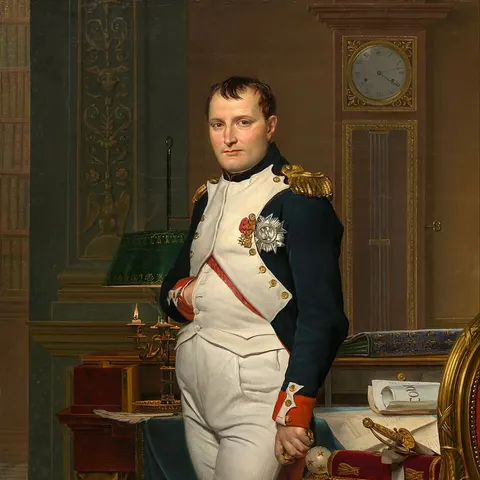
Key facts
- Estimated IQ
- IQ 145
- Known for
- French emperor, Napoleonic Code
- Lived
- Emperor of the French, 1769–1821
- Basis
- Cox 1926 historiometric estimate
- Confidence
- Low. No verified standardized IQ test exists; Napoleon died decades before modern IQ testing.
Napoleon was clearly an unusually capable strategic and administrative thinker. The 145 figure is Cox's 1926 corrected estimate, not a measured score.
What was Napoleon's IQ?
Napoleon never took an IQ test. The 145 usually quoted is Catharine Cox's 1926 corrected estimate, built from biographies of his youth: she rated him about 135 as a child and 140 as a young man. On modern norms that is closer to 125, so LifeScore uses 125 to 155.
How smart was Napoleon?
Very, in practical ways. He was commissioned as an artillery officer at 16 after mathematics-heavy training, chaired many of the sessions that drafted the Civil Code, and was famous for remembering units, officers and terrain in detail. Cox found military fame tracked IQ less than other fields.
How tall was Napoleon really?
About 1.69 metres, or roughly 5 feet 7 inches, average or slightly above for a Frenchman of his time. The myth that he was tiny comes from his height being recorded as 5 pieds 2 pouces in old French units, British cartoons, and his nickname le petit caporal.
Napoleon vs Alexander the Great: who was smarter?
Neither can be tested. Cox rated Napoleon at 145 but Alexander lived long before her study. Both were brilliant commanders; Alexander never lost a major battle, while Napoleon also rebuilt French law, education and administration, which gives him the broader documented record of civil achievement.
Where does the 145 figure come from?
The 145 traces to Catharine Cox's 1926 study of 301 eminent people. She rated Napoleon about 135 for childhood and 140 for ages 17 to 26, then corrected for gaps in the record. Secondary tables give that corrected figure as 145.
Cox also found that military leaders were the one group where her IQ ratings did not track eminence. Great generals were not reliably the brightest children.
Adjusted by about 22 points for the Flynn effect, 145 falls to roughly 123. LifeScore keeps 145 as the headline because it is the documented figure, with a working range of 125 to 155.
Napoleon Bonaparte's key achievements
- 01
Artillery officer at 16
He graduated from the École Militaire in one year and joined the artillery, the army's most mathematical branch. - 02
Toulon at 24
His artillery plan retook the port of Toulon in 1793 and made him a brigadier general at 24. - 03
The Civil Code
The 1804 Napoleonic Code set out civil law so clearly that versions of it still run legal systems worldwide. - 04
Austerlitz
In 1805 he lured a larger Austro-Russian army into attacking a weakened centre, then split it in two.
How Napoleon thought
Napoleon combined fast calculation of time and distance with an obsessive memory for detail. He planned campaigns around speed, dividing his army to march and concentrating it to fight. Off the battlefield he applied the same system-building to law, schools and the state.
The evidence behind the estimate
An estimate built from the historical record, not a recovered test score.
What supports it
- His strongest school subjects were mathematics and history, while his overall record was uneven.
- He qualified for artillery, a branch whose training depended heavily on mathematics.
- His documented reading, memory for operational detail and ability to coordinate military and civil systems support exceptional applied reasoning.
- Cox rated him about 135 for childhood and 140 for young adulthood; secondary tables give his corrected estimate as 145.
What it cannot prove
- School rank and achievement are not interchangeable with IQ.
- Cox herself found that military eminence was the one field where childhood IQ did not track eminence.
- A modern score cannot be reconstructed precisely from eighteenth-century records.
Napoleon compared with Alexander, Caesar, Hannibal
| Figure | Estimate | Range |
|---|---|---|
| Napoleon Bonaparte | 145 | 125–155 |
| Alexander the Great | 150+ | 135–160 |
| Julius Caesar | 150+ | 135–160 |
| Hannibal Barca | 140+ | 130–150 |
Psychological profile
Napoleon Bonaparte's IQ is represented here by a retrospective estimate of 145, not a verified test result. Napoleon Bonaparte is best known for exceptional strategic planning. The useful question is what the surviving evidence shows, not whether a precise modern score can be recovered.
Extreme Conscientiousness and High Neuroticism (managed). A master of memory and detail.
The dominant archetype here is The Ruler. This archetype shapes decision patterns: what feels natural, what creates friction, and what blind spots tend to emerge.
Estimated IQ is 145. This is a rough estimate based on documented accomplishments and contemporary accounts, not a literal measurement.
Key traits
Strategic Planning
Napoleon demonstrated exceptional long-term planning ability: modelling complex systems and anticipating opponents' moves far in advance.Workaholism
Documented work patterns suggest near-obsessive output levels. This is often called "hard work", but it is more accurate to describe it as compulsive engagement with the domain.Charisma
Napoleon had unusual social influence: the ability to make others believe in a vision even when the odds looked poor.
One thing most people do not know
Napoleon was elected to the science class of the French Institute in 1797. A geometry result, Napoleon's theorem, carries his name, though his authorship is doubtful.
A modern parallel
Elon Musk shows a contemporary version of Napoleon's working style. The era is different, but patterns such as risk tolerance and social strategy look similar. This is not an IQ comparison.
Napoleon Bonaparte: common questions
Was Napoleon Bonaparte a genius?
What personality type was Napoleon Bonaparte?
Who is the modern equivalent of Napoleon Bonaparte?
What can we learn from Napoleon Bonaparte?
People with similar IQ estimates
Napoleon Bonaparte's estimate of 145 falls in the genius level IQ range. See what an IQ of 145 means, place it on the IQ chart or check how rare it is with the IQ rarity calculator.
 Queen Elizabeth I's IQQueen of England, estimated 145+145+
 Franklin D. Roosevelt's IQUS President, estimated 145+145+
 Sun Tzu's IQMilitary Strategist, estimated 145+145+
 Theodore Roosevelt's IQUS President, estimated 145+145+
 Ada Lovelace's IQMathematician (Early Computing), estimated 145145
Head-to-head
- Napoleon Bonaparte vs Ada LovelaceSide-by-side IQ estimates and evidence
- Napoleon Bonaparte vs Alexander the GreatSide-by-side IQ estimates and evidence
- Napoleon Bonaparte vs Marie CurieSide-by-side IQ estimates and evidence
- Napoleon Bonaparte vs CleopatraSide-by-side IQ estimates and evidence
- Isaac Newton vs Napoleon BonaparteSide-by-side IQ estimates and evidence
Keep exploring
- Rapid Verbal ProcessingSign of high intelligence
- Exceptional Memory RetentionSign of high intelligence
- Dexter (Dexter's Laboratory)'s IQDexter's Laboratory, fan estimate 145
- Doctor Strange's IQMarvel Cinematic Universe, fan estimate 145
- Elon Musk: psychological profileA modern parallel
People also search for
All 157 historical IQ estimates, ranked with ranges and sources.
Napoleon's IQ is 145. What's yours?
Napoleon's estimate comes from the historical record. Yours can come from a real test: 25 visual reasoning questions.
25 questions · about 12 minutes
Sources
- Was Napoleon a good pupil?, Fondation Napoléon. Reviews Napoleon’s mixed school record, including strength in mathematics and history.
- Chronology: the Consulate and First Empire, Fondation Napoléon. Provides educational and career context for his early development.
- The Early Mental Traits of Three Hundred Geniuses (Cox, 1926), Stanford University Press, via Internet Archive. The original historiometric study. Cox rated 301 eminent people born 1450 to 1850 from biographical records of their childhood and youth.
- Cox's IQ estimates of 301 eminent geniuses, IQ Comparison Site. Secondary tabulation of Cox's corrected estimates, with a version adjusted by about 22 points for the Flynn effect.
- Cox, C. M. (1926). The Early Mental Traits of Three Hundred Geniuses. Stanford University Press.
- Simonton, D. K. (2009). Genius 101. Springer.
- Cattell, R. B. (1971). Abilities: Their Structure, Growth, and Action. Houghton Mifflin.
- Portrait: Jacques-Louis David · Public domain · Wikimedia Commons
Last reviewed September 2026. How we estimate historical IQ