Winston Churchill IQ
Winston Churchill's IQ is estimated at around 135, within a range of 125 to 145. He never took an IQ test; the estimate rests on his writing and career.
Churchill's IQ is 135. What's yours?
25 questions · about 12 minutes
Think you're smarter than Winston Churchill? Try question 1.
Which option completes the grid? One tap, no sign-up.
Key facts
- Estimated IQ
- IQ 135
- Known for
- Wartime prime minister, Nobel author
- Lived
- Prime Minister, 1874–1965
- Basis
- Documented writing and career record; no test
- Confidence
- Low. No verified modern IQ score has been published.
Churchill’s literary output, historical synthesis and rhetoric demonstrate strong verbal ability; the exact number 135 remains speculative.
What was Winston Churchill's IQ?
No IQ score for Churchill exists. LifeScore estimates about 135, with a range of 125 to 145, based on his writing, speeches and career. He was born in 1874, too late for Cox's 1926 study, and his uneven schooling makes a childhood-based estimate unreliable.
Was Winston Churchill a genius?
In verbal and historical terms, many would say yes. He won the 1953 Nobel Prize in Literature, wrote dozens of books and gave some of the most quoted speeches in English. But he struggled at school and needed three attempts to enter Sandhurst, so his gifts were uneven.
How smart was Churchill?
Very smart with words and history, less so in exams. At Harrow he was placed in the lowest form, yet he could recite long passages of poetry and later wrote a six-volume history of the Second World War. His strength was synthesis and persuasion under pressure.
Winston Churchill's key achievements
- 01
Nobel Prize in Literature
He won the 1953 prize for his historical and biographical writing and his oratory. - 02
A writing machine
He wrote dozens of books, from war reporting in his twenties to a four-volume history of the English-speaking peoples. - 03
1940 speeches
Speeches such as "We shall fight on the beaches" helped hold Britain together in the war's darkest months. - 04
Painter
He took up painting at 40 and produced hundreds of canvases.
How Churchill thought
Churchill thought in narratives. He read history hungrily, framed events as chapters in a long story and used that frame to persuade. He dictated much of his writing, pacing the room, and revised speeches heavily for rhythm.
The evidence behind the estimate
An estimate built from the historical record, not a recovered test score.
What supports it
- He produced an unusually large body of speeches, history, biography and journalism.
- The Nobel committee awarded him the 1953 Literature prize for historical and biographical writing and oratory.
- His conventional school performance was uneven, and he entered Sandhurst on his third attempt, showing why biography cannot be reduced to one academic signal.
What it cannot prove
- Literary achievement measures expertise, practice and opportunity as well as ability.
- Political success cannot be converted directly into psychometric points.
- No test record is available for independent verification.
Churchill compared with FDR, Lincoln, Napoleon
| Figure | Estimate | Range |
|---|---|---|
| Winston Churchill | 135 | 125–145 |
| Franklin D. Roosevelt | 145+ | 130–155 |
| Abraham Lincoln | 140+ | 130–150 |
| Napoleon Bonaparte | 145 | 125–155 |
How would you score?
Where would you land next to Winston Churchill?
Winston Churchill's 135 is an estimate from the historical record, with a working range of 125 to 145. On the standard IQ scale an IQ of 135 sits at the 99th percentile: about 1 in 102 people score that high. Nobody can test Churchill now. You can find out where you sit on the same scale.
- 100Average adult50th percentile
- 130Gifted linetop 2%, about 1 in 44
- 135Churchill's99th percentile, about 1 in 102
- ?Youscored on the same scale
25 questions · about 12 minutes
Psychological profile
Winston Churchill's IQ is represented here by a retrospective estimate of 135, not a verified test result. Winston Churchill is best known for exceptional rhetoric. The useful question is what the surviving evidence shows, not whether a precise modern score can be recovered.
High Verbal IQ and resilience to depression ("The Black Dog"). Thrived in chaos.
The dominant archetype here is The Warrior. This archetype shapes decision patterns: what feels natural, what creates friction, and what blind spots tend to emerge.
Estimated IQ is 135. This is a rough estimate based on documented accomplishments and contemporary accounts, not a literal measurement.
Key traits
Rhetoric
Winston used language as a tool of influence, crafting arguments that moved populations and shifted policy.Stubbornness
Winston held positions even when evidence suggested reconsidering. This trait enables persistence but also creates blind spots.Resilience
Winston recovered from setbacks that would have ended most careers. This suggests high distress tolerance and fast emotional recovery.
One thing most people do not know
At Harrow Churchill won a prize for reciting 1,200 lines of Macaulay's Lays of Ancient Rome from memory.
Winston Churchill: common questions
What personality type was Winston Churchill?
What can we learn from Winston Churchill?
The IQ-style test the NFL used
Winston Churchill's IQ is an estimate. Yours could be real.
Before the draft, NFL teams gave prospects the Wonderlic: 50 questions in 12 minutes, and almost nobody finishes. We collected 241 reported player scores, each with its source. The average working adult scores about 21.
People with similar IQ estimates
Winston Churchill's estimate of 135 falls in the gifted IQ range. Want your own number rather than Winston's? Take the free IQ test or the quick IQ test. See what an IQ of 135 means, place it on the IQ chart or check how rare it is with the IQ rarity calculator.
 Alexander Hamilton's IQUS Founding Father & Treasury Secretary, estimated 135+135+
- Ashoka's IQMauryan Emperor, estimated 135135
- Garry Kasparov's IQChess Grandmaster, estimated 135135
- Henry VIII's IQKing of England, estimated 135135
 John Adams' IQ2nd US President & Founding Father, estimated 135+135+
Head-to-head
- Winston Churchill vs Franklin D. RooseveltSide-by-side IQ estimates and evidence
- Winston Churchill vs Nelson MandelaSide-by-side IQ estimates and evidence
Rankings that include Churchill
- The highest IQ Nobel Prize winnersRanked 31 of 35
Keep exploring
- Complex Problem DecompositionSign of high intelligence
- Subtle Signs Someone is Smarter Than You ThinkSign of high intelligence
- Atticus Finch's IQTo Kill a Mockingbird, fan estimate 135
- Kaguya Shinomiya's IQKaguya-sama: Love Is War, fan estimate 135
People also search for
All 307 historical IQ estimates, ranked with ranges and sources.
Churchill's IQ is 135. What's yours?
Churchill's estimate comes from the historical record. Yours can come from a real test: 25 visual reasoning questions.
25 questions · about 12 minutes
Sources
- Winston Churchill – Biographical, Nobel Prize. Documents his education, public career and extensive authorship.
- Award ceremony speech, Nobel Prize. Explains the literary and oratorical basis of Churchill’s Nobel Prize.
- Cox, C. M. (1926). The Early Mental Traits of Three Hundred Geniuses. Stanford University Press.
- Simonton, D. K. (2009). Genius 101. Springer.
- Cattell, R. B. (1971). Abilities: Their Structure, Growth, and Action. Houghton Mifflin.
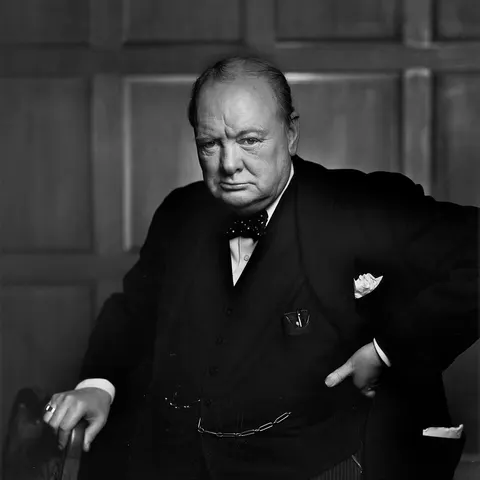
- Portrait: Yousuf Karsh · Public domain · Wikimedia Commons
Last reviewed September 2026. How we estimate historical IQ