Alexander Hamilton IQ
Alexander Hamilton's IQ is estimated at 133 to 155. Catharine Cox's 1926 study gave him a corrected 155; he never took a test. His record as a writer and designer of the early US financial system is the stronger evidence.
Hamilton's IQ is 135+. What's yours?
25 questions · about 12 minutes
Key facts
- Estimated IQ
- 135+
- Known for
- The Federalist Papers and the first US financial system
- Lived
- US Founding Father & Treasury Secretary, 1755–1804
- Basis
- Cox 1926 historiometric estimate
- Confidence
- Low. Hamilton died in 1804. No IQ test was ever given; the figure comes from a 1926 study that rated historical figures from biographies.
Cox's corrected estimate for Hamilton was 155, a little below Jefferson's 160. His writing and financial design are the stronger evidence, and they are fully documented.
What was Alexander Hamilton's IQ?
Hamilton never took an IQ test. Catharine Cox's 1926 study of 301 eminent people gave him a corrected estimate of 155. Adjusted for the Flynn effect that is about 133, so LifeScore uses a working range of 133 to 155, with 135+ as the marker.
How much of the Federalist Papers did Hamilton write?
Hamilton wrote 51 of the 85 essays, with James Madison writing most of the rest and John Jay a handful. The essays appeared in New York newspapers in 1787 and 1788 to argue for ratifying the Constitution, and Hamilton did much of the work in weeks.
Was Hamilton smarter than Jefferson?
Cox's 1926 figures put Jefferson higher, 160 against 155. They shaped the country in opposite ways: Hamilton designed a national bank and a federal debt system, while Jefferson wrote the Declaration of Independence. Both mattered, and Cox's gap of five points is far inside her margin of error.
Where does the 155 figure come from?
The 155 is Catharine Cox's corrected estimate from her 1926 study of 301 eminent people born between 1450 and 1850. She rated each person from biographical records of what they could do as a child and young adult, then corrected for gaps in the record.
Cox's numbers sit on an old ratio-IQ scale. One secondary tabulation subtracts about 22 points for the Flynn effect, which puts Alexander Hamilton near 135.
LifeScore lists 135+, and the working range of 135 to 155 spans both figures. None of them is a test result.
How smart was Alexander Hamilton?
- 01
Running a trading house at about 14
As a teenage clerk in St Croix he handled accounts and shipments for a merchant firm while its owner was away. - 02
The Federalist Papers
He wrote 51 of the 85 essays arguing for the US Constitution in 1787 and 1788. - 03
First Treasury Secretary
From 1789 to 1795 he set up the national debt system, the First Bank of the United States and the US Mint. - 04
Report on Manufactures
His 1791 report argued for government support of American industry.
How Hamilton thought
Hamilton thought in systems and wrote at speed. He took a problem, such as how a new country could pay its war debts, and designed a full structure of banks, taxes and credit to solve it, then wrote the argument for it himself.
The evidence behind the estimate
An estimate built from the historical record, not a recovered test score.
What supports it
- Cox's 1926 study gave Hamilton a corrected estimate of 155, which falls to about 133 after a Flynn-effect adjustment.
- He wrote 51 of the 85 Federalist essays in 1787 and 1788.
- As Treasury Secretary he established the national debt system, the First Bank of the United States and the Mint.
What it cannot prove
- Cox rated childhood and youth from biographies, and his childhood record is thin and disputed, including his birth year.
- Cox's scale runs higher than modern deviation IQ, by roughly 22 points in one tabulation.
- Political skill and influence depend on allies, timing and personality as well as ability.
Hamilton compared with Jefferson, Franklin, Washington
| Figure | Estimate | Range |
|---|---|---|
| Alexander Hamilton | 135+ | 135–155 |
| Thomas Jefferson | 150+ | 140–160 |
| Benjamin Franklin | 150+ | 140–160 |
| George Washington | 120+ | 120–140 |
Psychological profile
Alexander Hamilton's IQ is represented here by a retrospective estimate of 135+, not a verified test result. Alexander Hamilton is best known for exceptional rapid writing. The useful question is what the surviving evidence shows, not whether a precise modern score can be recovered.
Driven, fast and prolific. An orphaned immigrant who built his career on writing, argument and financial design.
The dominant archetype here is The Statesman. This archetype shapes decision patterns: what feels natural, what creates friction, and what blind spots tend to emerge.
Estimated IQ is 135+. This is a rough estimate based on documented accomplishments and contemporary accounts, not a literal measurement.
Key traits
Rapid Writing
He wrote his famous Federalist essays alongside a full-time legal practice.Financial Design
He grew up poor in the Caribbean and was sent to New York partly on the strength of a letter describing a hurricane.Ambition
His fierce arguments made powerful enemies and ended in a duel with Aaron Burr in 1804.
One thing most people do not know
Hamilton was killed in a duel with Aaron Burr in July 1804 and died the next day.
Alexander Hamilton: common questions
Was Alexander Hamilton a genius?
What personality type was Alexander Hamilton?
What can we learn from Alexander Hamilton?
More famous IQs
 Thomas Jefferson IQUS Founding Father150+
 Benjamin Franklin IQPolymath & Founding Father150+
 George Washington IQUS Founding Father & President120+
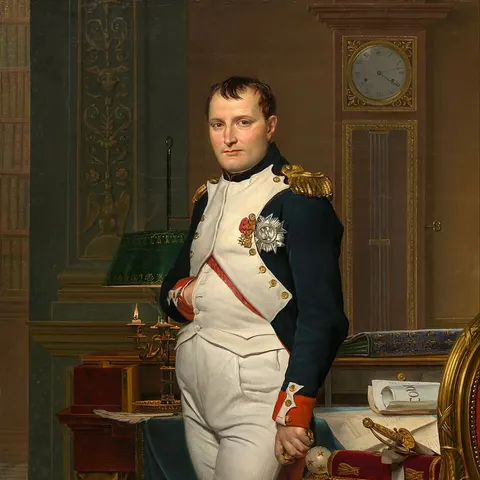 Napoleon Bonaparte IQEmperor of the French145
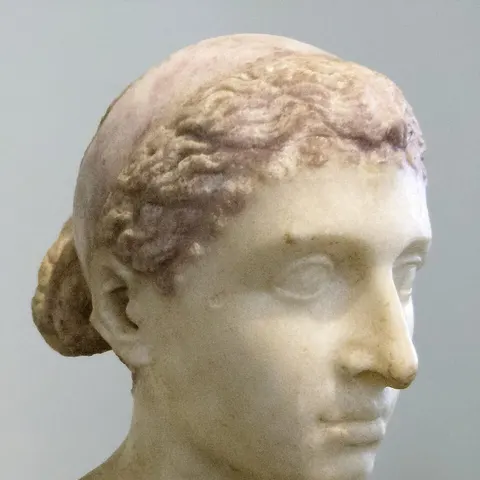 Cleopatra IQPharaoh of Egypt140
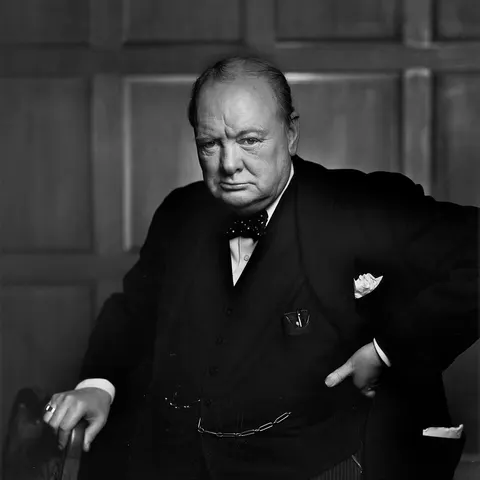 Winston Churchill IQPrime Minister135
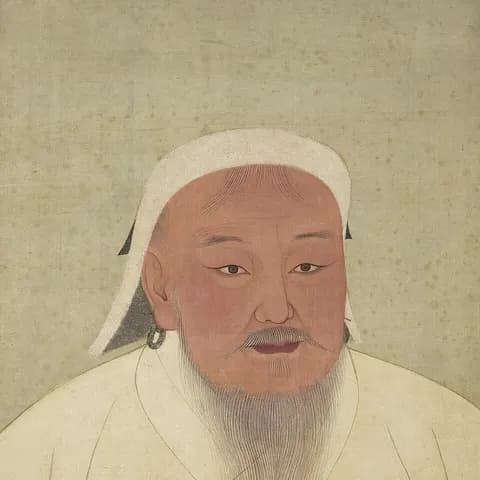 Genghis Khan IQFounder of the Mongol Empire130+
 Joan of Arc IQFrench Military Leader120+
Keep exploring
- All famous IQs, ranked157 figures with ranges and sources
- What an IQ of 135 meansPercentile, rarity and classification
- What an IQ of 155 meansPercentile, rarity and classification
- Quick Pattern RecognitionSigns of high intelligence
- Rapid Learning SpeedSigns of high intelligence
- Einstein IQ testA short visual reasoning challenge
Hamilton's IQ is 135+. What's yours?
Hamilton's estimate comes from the historical record. Yours can come from a real test: 25 visual reasoning questions.
25 questions · about 12 minutes
Sources
- Alexander Hamilton, Encyclopaedia Britannica. Biography covering his youth, the Federalist Papers, the Treasury and the duel with Burr.
- The Early Mental Traits of Three Hundred Geniuses (Cox, 1926), Stanford University Press, via Internet Archive. The original historiometric study. Cox rated 301 eminent people born 1450 to 1850 from records of their childhood and youth.
- Cox's IQ estimates of 301 eminent geniuses, IQ Comparison Site. Secondary tabulation of Cox's corrected estimates, with a version adjusted by about 22 points for the Flynn effect.
- Cox, C. M. (1926). The Early Mental Traits of Three Hundred Geniuses. Stanford University Press.
- Simonton, D. K. (2009). Genius 101. Springer.
- Cattell, R. B. (1971). Abilities: Their Structure, Growth, and Action. Houghton Mifflin.
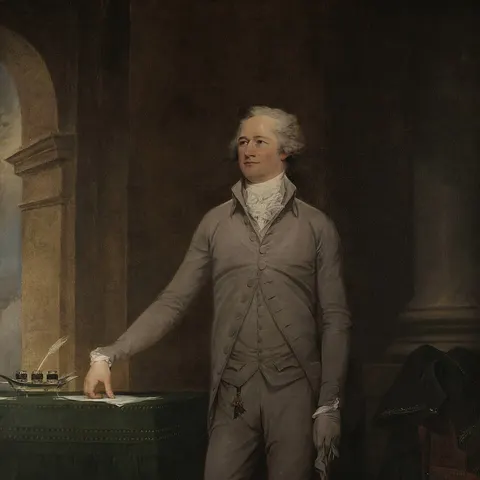
- Portrait: John Trumbull · Public domain · Wikimedia Commons
Last reviewed September 2026. How we estimate historical IQ