Albert Einstein Psychology & Personality
Developed the theory of relativity and reshaped modern physics. This page covers Albert Einstein's psychology: personality traits, cognitive style and key decisions. For the IQ estimate, ranges and sources, see Albert Einstein's IQ profile.
What's your IQ?
25 questions · about 12 minutes
What would you score? Try question 1.
Which option completes the grid? One tap, no sign-up.
Key facts
- Known for
- Theoretical Physicist
- Estimated IQ
- 160+. Full estimate and sources
- Basis
- Editorial estimate from public evidence. No verified test score.
- Archetype
- The Sage
- Fields
- Physics, Mathematics, Philosophy
This profile interprets the public record: biographies, interviews and documented events. It is not a clinical diagnosis. Editorial policy
Key takeaways
- Imagination can be a precision tool when it tests constraints, not fantasies.
- Reduce problems to invariants, what must remain true across changes.
- Deep work and incubation are compatible: focus, then let the mind integrate.
- Institutional fit matters: independence thrives with fewer status pressures.
- Low day-to-day order can coexist with extreme conceptual rigor.
Profile summary
Einstein’s edge wasn’t raw calculation alone, it was a cognitive style built for fundamentals: relentless curiosity, comfort with uncertainty, and the habit of translating problems into simple thought experiments. The signature move is conceptual compression: reduce a messy problem to a small set of constraints and invariants, then reason until a coherent model becomes inevitable. This requires patience for confusion, because the path is not linear, periods of deep focus alternate with incubation, where the mind keeps integrating in the background. The same independence that enabled conceptual breakthroughs also produced predictable friction with institutions and routine. Biographical accounts often describe disorganization in daily life alongside exceptional intellectual persistence. In modern terms, it’s a “deep work + first principles” profile: extraordinary upside when given room to think, weaker performance when forced into narrow compliance. The practical lesson is not to imitate genius, but to adopt the method: choose a hard problem, protect quiet focus, test assumptions with small thought experiments, and keep returning to the invariants.
Psychological traits
Openness
HighHigh curiosity and willingness to challenge assumptions; strong appetite for novel conceptual frames.Conscientiousness (routine)
LowDisorganized in daily life and bureaucratic routines; prefers thinking to procedure.Intellectual independence
HighResists authority pressure when it conflicts with internal coherence.Tolerance for ambiguity
HighAble to sit with confusion for long periods while a model crystallizes.Focus depth
HighCapable of sustained attention on a small set of fundamental questions.Social conventionality
LowLess motivated by status norms; can clash with institutions optimized for compliance.
Cognitive style
Strengths
- First-principles reasoning (invariants, symmetry, constraints)
- Thought experiments to test intuition
- Long-horizon persistence on hard problems
- Intellectual independence
Risks and tradeoffs
- Low tolerance for bureaucratic routine
- Messy execution in day-to-day organization
- Institutional friction when systems reward conformity
- Delayed output if coherence takes priority over deadlines
How it shows up
- Prefers conceptual clarity over procedural compliance
- Uses imagination as a tool for precision (not fantasy)
- Works in deep focus bursts followed by incubation
- Returns to invariants when complexity explodes
Psychological timeline
Patent Office
1902A context with fewer academic status pressures; careful reasoning and independent thinking can incubate.Annus Mirabilis
1905Breakthrough cluster consistent with conceptual compression and deep focus across a small set of fundamentals.General Relativity
1915Long-horizon persistence: years of uncertainty tolerated before synthesis and formalization.Nobel Prize
1921Institutional validation arrives later; suggests the primary drive is coherence and truth-seeking rather than acclaim.
Evidence from the public record
- 01
Thought experiments were a recurring method for testing constraints.
Relativity is widely explained through gedankenexperiments (for example: chasing a beam of light, elevators and equivalence). Biographical treatments emphasize this as a consistent working style: use imagination to simulate constraints until a contradiction appears or coherence emerges. This supports the interpretation of imagination as a precision instrument for reasoning.
Sources: Einstein: His Life and Universe, Walter Isaacson, 2007; Subtle is the Lord, Abraham Pais, 1982
- 02
Independent thinking matured outside elite institutional tracks early on.
The early career included the Swiss Patent Office, often described as a context that rewarded careful reasoning while reducing academic status pressure. That environment plausibly protected independent cognition and gave space for incubation. This supports the “institutional fit” lens: freedom from narrow compliance can amplify deep work.
Sources: Einstein: His Life and Universe, Walter Isaacson, 2007; Historical accounts of the Swiss Patent Office period, 1902 to 1909
- 03
Low routine order coexisted with extreme conceptual persistence.
Accounts commonly describe day-to-day disorganization alongside sustained attention to a small set of fundamental problems. The output pattern, long periods of uncertainty followed by synthesis, supports a profile where conceptual coherence is prioritized over visible busyness. This is consistent with high openness and tolerance for ambiguity, with low routine conscientiousness.
Sources: Subtle is the Lord, Abraham Pais, 1982; Einstein: His Life and Universe, Walter Isaacson, 2007
Decision patterns
Reduce to invariants
Identifies what must remain true under transformation, then builds the model around it.
Tradeoff: Applied implementation can lag because coherence is prioritized over practicality early on.
Independent truth-seeking
Resists consensus when it conflicts with internal logic and constraint coherence.
Tradeoff: Creates institutional tension and can isolate the thinker from collaborators.
Incubation + synthesis
Lets problems sit, then returns with a clearer frame rather than brute-force grinding.
Tradeoff: Looks like procrastination to environments optimized for visible busyness.
The mindset in brief
In Albert Einstein's words
“Imagination is more important than knowledge.”
Key lessons
- Curiosity
- Non-conformity
- Deep work
Misconceptions
Einstein ‘failed math’ and only succeeded through imagination.
Accounts generally describe strong ability; imagination was used to test constraints, not to avoid mathematics.Genius is pure talent.
Durable output requires curiosity, tolerance for confusion, persistence, and an environment that protects deep work.
Recommended reading
Einstein: His Life and Universe
Walter Isaacson, 2007
Balanced biography with cognitive and institutional context.Subtle is the Lord
Abraham Pais, 1982
Deeper scientific biography for how the ideas evolved.
Albert Einstein: common questions
What was Albert Einstein’s most distinctive cognitive advantage?
Is the “Einstein IQ 160+” claim verified?
Did Einstein struggle in school?
How did Einstein work day-to-day?
What can a normal person realistically learn from Einstein?
Is genius mostly talent or training?
More profiles
- Bill GatesCo-Founder of Microsoft160
- Elon MuskTechnoking of Tesla155
- Jordan PetersonClinical Psychologist and Professor150
- Ariana GrandeGrammy-Winning Artist and Actress131
- Barack Obama44th President of the United States
- BeyonceArtist and Business Mogul136
- Cristiano RonaldoProfessional Footballer and Global Sports Icon126
- Donald Trump45th and 47th President of the United States
- Dwayne JohnsonActor, Producer, and Former Professional Wrestler125
- Emma WatsonActress, Activist, and UN Women Goodwill Ambassador138
- Jeff BezosFounder of Amazon150+
- Joe RoganPodcast Host and Commentator127
Historical figures like Albert Einstein
- Albert Einstein IQ20th Century160+
 Mahatma Gandhi IQ20th Century125+
 Socrates IQAncient Greece155+
- Confucius IQAncient China145+
Keep exploring
- Personality TestWho are you?
- ConscientiousnessPersonality
- Openness to ExperiencePersonality
- University of TokyoAverage IQ 138
- All public figure profilesModern minds, profiled from the public record
- Famous IQs in historyHistorical figures ranked with ranges and sources
- All testsEvery LifeScore assessment
- Psychology glossaryKey terms explained
What's your IQ?
Personality shows how someone decides. The IQ test measures reasoning: 25 visual reasoning questions.
25 questions · about 12 minutes
Sources
- Einstein: His Life and Universe, Walter Isaacson, 2007
- Subtle is the Lord, Abraham Pais, 1982
- The Collected Papers of Albert Einstein (selected), 1987–
- 1905 papers (special relativity, photoelectric effect, Brownian motion), 1905
- General relativity publications and notes (selected), 1915
- Historical accounts of the Swiss Patent Office period, 1902 to 1909
- Simonton, D. K. (2006). Presidential IQ, openness, intellectual brilliance, and leadership. Political Psychology, 27(4), 511-526.
- McCrae, R. R., & Costa, P. T. (2008). The Five-Factor Theory of Personality. In O. P. John et al. (Eds.), Handbook of Personality (3rd ed.).
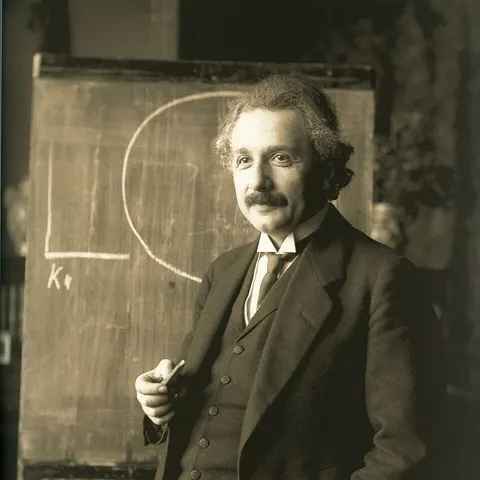
- Portrait: Ferdinand Schmutzer / Adam Cuerden · Public domain · Wikimedia Commons
Last reviewed August 2026.