Alfred Nobel IQ
Alfred Nobel's IQ is unknown; no test or confirmed study figure exists. LifeScore uses about 145 (range 130 to 160) as an editorial marker for the inventor of dynamite, who held 355 patents and created the Nobel Prizes.
Nobel's IQ is 145. What's yours?
25 questions · about 12 minutes
Think you're smarter than Alfred Nobel? Try question 1.
Which option completes the grid? One tap, no sign-up.
Key facts
- Estimated IQ
- IQ 145
- Known for
- Inventing dynamite and founding the Nobel Prizes
- Lived
- Chemist, Inventor & Industrialist, 1833–1896
- Basis
- No documented estimate; editorial marker from the record
- Confidence
- Very low. Born inside the period Cox 1926 covered, but we could not confirm a Cox figure from an accessible tabulation, so none is quoted. No IQ test was ever given.
Nobel has no test and no Cox figure we could confirm. 145 is an editorial marker for a multilingual inventor and industrialist with 355 patents.
Alfred Nobel in brief
Alfred Nobel was born in Stockholm in 1833 and grew up partly in Saint Petersburg, where his father made mines for the Russian army. Educated by private tutors, he spoke several languages fluently. He worked on nitroglycerine, which killed his younger brother Emil in an 1864 explosion, and in 1867 patented dynamite. He built a business empire across Europe, held 355 patents and left most of his fortune to create the Nobel Prizes.
What was Alfred Nobel's IQ?
No figure exists. LifeScore lists about 145 as an editorial marker, range 130 to 160. It rests on his mastery of several languages as a teenager, his chemistry and engineering, and the scale of the industrial business he built around his inventions.
Why did Alfred Nobel create the prizes?
A popular story says a premature 1888 obituary calling him "the merchant of death" made him think about his legacy. Whatever the reason, his 1895 will left most of his fortune for annual prizes in physics, chemistry, medicine, literature and peace, first awarded in 1901.
How did Nobel invent dynamite?
Nitroglycerine was powerful but dangerously unstable. In 1867 Nobel found that absorbing it into kieselguhr, a porous earth, made a paste that could be shaped into sticks and handled safely, then set off with a detonator he had also invented.
How smart was Alfred Nobel?
- 01
Dynamite
Patented in 1867, it transformed mining and construction. - 02
The blasting cap
A reliable detonator for nitroglycerine explosives. - 03
355 patents
Inventions in explosives, synthetic materials and more. - 04
The Nobel Prizes
Created by his will and first awarded in 1901.
How Nobel thought
Nobel combined chemistry with engineering and business. He solved the practical problem, making an unstable substance safe, then built factories and companies to exploit it. That is applied, goal-directed problem solving across several domains.
The evidence behind the estimate
An estimate built from the historical record, not a recovered test score.
What supports it
- He held 355 patents in several countries.
- He was educated privately and spoke at least five languages fluently.
- He built an international industrial business of factories and companies.
What it cannot prove
- Much of his success depended on family capital and engineering teams.
- Achievement reflects education, opportunity, persistence and collaboration as well as raw reasoning ability.
- An editorial marker is a comparison aid built from achievement, not a measurement, and two careful readers could place it ten points apart.
Nobel compared with Edison, Tesla, Bell
| Figure | Estimate | Range |
|---|---|---|
| Alfred Nobel | 145 | 130–160 |
| Thomas Edison | 145 | 130–155 |
| Nikola Tesla | 160+ | 145–170 |
| Alexander Graham Bell | 145 | 130–160 |
How would you score?
Where would you land next to Alfred Nobel?
Alfred Nobel's 145 is an estimate from the historical record, with a working range of 130 to 160. On the standard IQ scale an IQ of 145 sits at the 99.87th percentile: about 1 in 741 people score that high. Nobody can test Nobel now. You can find out where you sit on the same scale.
- 100Average adult50th percentile
- 130Gifted linetop 2%, about 1 in 44
- 145Nobel's99.87th percentile, about 1 in 741
- ?Youscored on the same scale
25 questions · about 12 minutes
Psychological profile
Alfred Nobel's IQ is represented here by a retrospective estimate of 145, not a verified test result. Alfred Nobel is best known for exceptional invention. The useful question is what the surviving evidence shows, not whether a precise modern score can be recovered.
Lonely, restless and inventive. A wealthy industrialist who wrote poetry and worried about his legacy.
The dominant archetype here is The Inventor. This archetype shapes decision patterns: what feels natural, what creates friction, and what blind spots tend to emerge.
Estimated IQ is 145. This is a rough estimate based on documented accomplishments and contemporary accounts, not a literal measurement.
Key traits
Invention
By 17 he reportedly spoke Swedish, Russian, French, English and German.Languages
A French newspaper in 1888 mistakenly ran his obituary under the headline "The merchant of death is dead".Business Sense
His 1895 will left about 94 percent of his fortune to fund the prizes.
One thing most people do not know
The element nobelium, number 102, is named after him.
Alfred Nobel: common questions
Was Alfred Nobel a genius?
What personality type was Alfred Nobel?
What can we learn from Alfred Nobel?
The IQ-style test the NFL used
Alfred Nobel's IQ is an estimate. Yours could be real.
Before the draft, NFL teams gave prospects the Wonderlic: 50 questions in 12 minutes, and almost nobody finishes. We collected 241 reported player scores, each with its source. The average working adult scores about 21.
People with similar IQ estimates
Alfred Nobel's estimate of 145 falls in the genius level IQ range. Want your own number rather than Alfred's? Take the free IQ test or the quick IQ test. See what an IQ of 145 means, place it on the IQ chart or check how rare it is with the IQ rarity calculator.
- Warren Buffett's IQInvestor, estimated 145+145+
- Alexander Graham Bell's IQInventor & Teacher of the Deaf, estimated 145145
- Johannes Gutenberg's IQInventor & Printer, estimated 145145
- Wilbur and Orville Wright's IQAviation Pioneers, estimated 145145
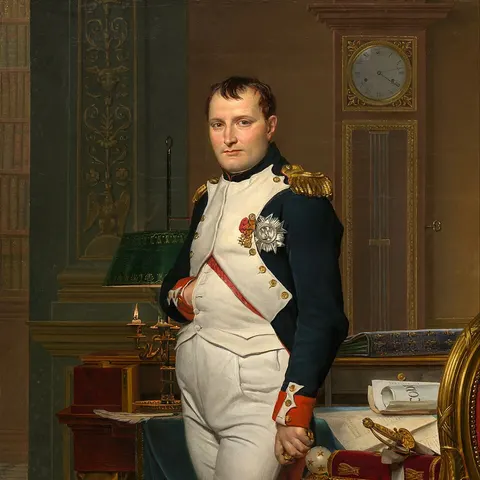 Napoleon Bonaparte's IQEmperor of the French, estimated 145145
Rankings that include Nobel
- The highest IQ inventors in historyRanked 13 of 21
Keep exploring
- Strong Self-Teaching AbilitySign of high intelligence
- Signs of High Emotional Intelligence (EQ)Sign of high intelligence
- Dexter (Dexter's Laboratory)'s IQDexter's Laboratory, fan estimate 145
- Doctor Strange's IQMarvel Cinematic Universe, fan estimate 145
People also search for
All 307 historical IQ estimates, ranked with ranges and sources.
Nobel's IQ is 145. What's yours?
Nobel's estimate comes from the historical record. Yours can come from a real test: 25 visual reasoning questions.
25 questions · about 12 minutes
Sources
- Alfred Nobel: his life and work, Nobel Prize. Official account of his life, inventions and will.
- Alfred Nobel, Encyclopaedia Britannica. Summarises dynamite, his business and the prizes.
- Cox, C. M. (1926). The Early Mental Traits of Three Hundred Geniuses. Stanford University Press.
- Simonton, D. K. (2009). Genius 101. Springer.
- Cattell, R. B. (1971). Abilities: Their Structure, Growth, and Action. Houghton Mifflin.
Last reviewed October 2026. How we estimate historical IQ