John Quincy Adams IQ
John Quincy Adams's IQ is estimated at 153 to 175. Catharine Cox's 1926 study gave him a corrected 175, higher than his father's; he never took a test. He travelled to Russia as a diplomat's secretary at 14.
Adams' IQ is 155+. What's yours?
25 questions · about 12 minutes
Key facts
- Estimated IQ
- 155+
- Known for
- Diplomacy, the Monroe Doctrine and arguing the Amistad case
- Lived
- 6th US President & Diplomat, 1767–1848
- Basis
- Cox 1926 historiometric estimate
- Confidence
- Low. Adams died in 1848. No IQ test was ever given; the figure comes from a 1926 study that rated historical figures from biographies.
Cox's corrected estimate for John Quincy Adams was 175, 20 points above his father. His diplomacy and diary are the documented evidence.
What was John Quincy Adams's IQ?
Adams never took an IQ test. Catharine Cox's 1926 study gave him a corrected estimate of 175. Adjusted for the Flynn effect that is about 153, so LifeScore uses a range of 153 to 175, with 155+ as the marker. His early diplomatic career is well documented.
How young was John Quincy Adams when he started diplomacy?
He travelled to Russia in 1781, aged 14, as secretary and French interpreter to the American envoy Francis Dana. He later served as minister to the Netherlands, Prussia, Russia and Britain, and was secretary of state under James Monroe from 1817 to 1825.
What was the Amistad case?
In 1841, aged 73, Adams argued before the Supreme Court for Africans who had seized the ship Amistad to escape slavery. He spoke for about eight hours across two days. The court ruled that they had been illegally enslaved and were free to go home.
Where does the 175 figure come from?
The 175 is Catharine Cox's corrected estimate from her 1926 study of 301 eminent people born between 1450 and 1850. She rated each person from biographical records of what they could do as a child and young adult, then corrected for gaps in the record.
Cox's numbers sit on an old ratio-IQ scale. One secondary tabulation subtracts about 22 points for the Flynn effect, which puts John Quincy Adams near 155.
LifeScore lists 155+, and the working range of 155 to 175 spans both figures. None of them is a test result.
How smart was John Quincy Adams?
- 01
A teenage diplomat
He travelled to Russia at 14 as a secretary to the US envoy. - 02
The Adams-Onis Treaty
As secretary of state in 1819 he negotiated the purchase of Florida from Spain. - 03
The Monroe Doctrine
He was the main author of the 1823 policy warning European powers against new colonies in the Americas. - 04
The Amistad case
He argued it before the Supreme Court in 1841 and won freedom for the captives.
How Adams thought
Adams worked through habit. He rose before dawn, read and wrote for hours and kept a diary of thousands of pages across almost 70 years. His diplomacy relied on preparation, languages and long memory for treaties and precedent.
The evidence behind the estimate
An estimate built from the historical record, not a recovered test score.
What supports it
- Cox's 1926 study gave Adams a corrected estimate of 175, which falls to about 153 after a Flynn-effect adjustment.
- He served as secretary to the US envoy in Russia at 14 and later as minister to four countries.
- He argued the Amistad case before the Supreme Court in 1841.
What it cannot prove
- His unusually documented childhood, thanks to a famous family, helps Cox's method give a higher figure.
- Success in diplomacy depends on connections and training as well as ability.
- Cox's scale runs higher than modern deviation IQ, by roughly 22 points in one tabulation.
Adams compared with Adams, Jefferson, Lincoln
| Figure | Estimate | Range |
|---|---|---|
| John Quincy Adams | 155+ | 155–175 |
| John Adams | 135+ | 135–155 |
| Thomas Jefferson | 150+ | 140–160 |
| Abraham Lincoln | 140+ | 130–150 |
Psychological profile
John Quincy Adams's IQ is represented here by a retrospective estimate of 155+, not a verified test result. John Quincy Adams is best known for exceptional languages. The useful question is what the surviving evidence shows, not whether a precise modern score can be recovered.
Disciplined, multilingual and intensely hard-working. A diplomat from his teens who kept a diary for most of his life.
The dominant archetype here is The Diplomat. This archetype shapes decision patterns: what feels natural, what creates friction, and what blind spots tend to emerge.
Estimated IQ is 155+. This is a rough estimate based on documented accomplishments and contemporary accounts, not a literal measurement.
Key traits
Languages
He spoke French, Dutch and German and read Latin and Greek.Diplomacy
He served in the House of Representatives after his presidency, from 1831 until he collapsed on its floor in 1848.Discipline
He was widely seen as cold in manner and found popular politics difficult.
One thing most people do not know
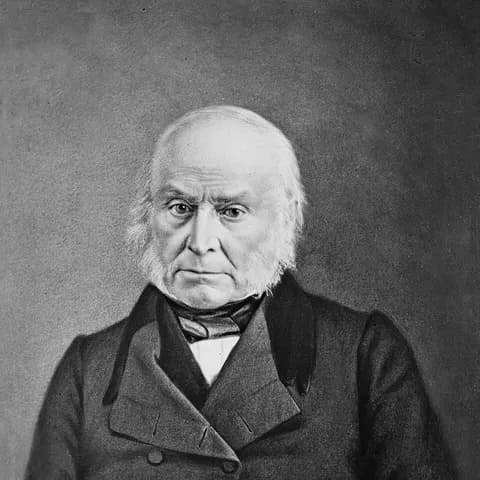
A daguerreotype from about 1843 makes Adams the earliest US president of whom a photograph survives.
John Quincy Adams: common questions
Was John Quincy Adams a genius?
What personality type was John Quincy Adams?
What can we learn from John Quincy Adams?
More famous IQs
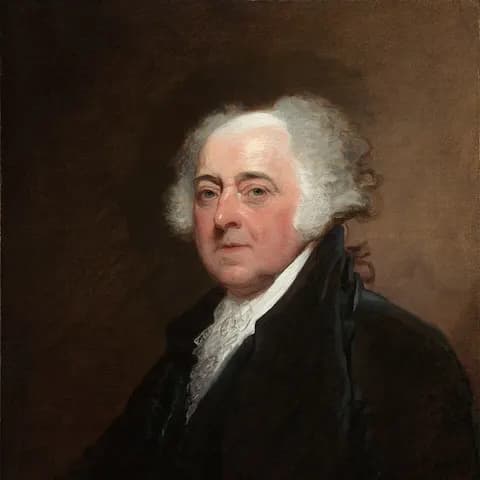 John Adams IQ2nd US President & Founding Father135+
 Thomas Jefferson IQUS Founding Father150+
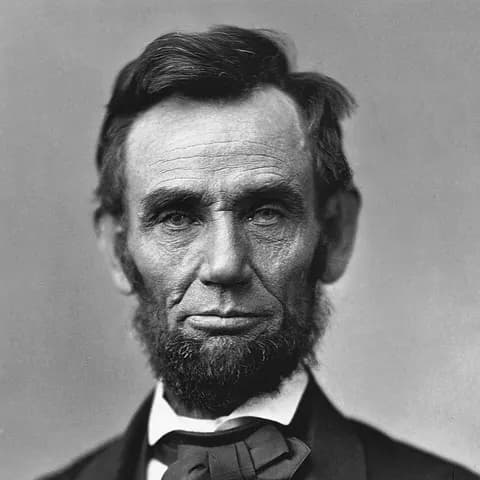 Abraham Lincoln IQPresident of the United States140+
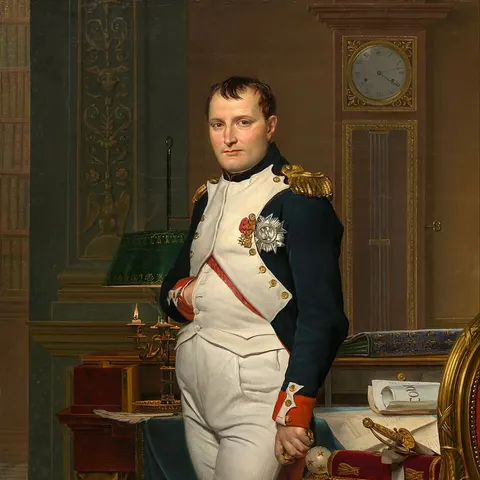 Napoleon Bonaparte IQEmperor of the French145
 Cleopatra IQPharaoh of Egypt140
 Winston Churchill IQPrime Minister135
 Genghis Khan IQFounder of the Mongol Empire130+
 Joan of Arc IQFrench Military Leader120+
Keep exploring
- All famous IQs, ranked157 figures with ranges and sources
- What an IQ of 155 meansPercentile, rarity and classification
- What an IQ of 175 meansPercentile, rarity and classification
- Quick Pattern RecognitionSigns of high intelligence
- Rapid Learning SpeedSigns of high intelligence
- Einstein IQ testA short visual reasoning challenge
Adams' IQ is 155+. What's yours?
Adams' estimate comes from the historical record. Yours can come from a real test: 25 visual reasoning questions.
25 questions · about 12 minutes
Sources
- John Quincy Adams, Encyclopaedia Britannica. Biography covering his diplomacy, presidency and later career in Congress.
- The Early Mental Traits of Three Hundred Geniuses (Cox, 1926), Stanford University Press, via Internet Archive. The original historiometric study. Cox rated 301 eminent people born 1450 to 1850 from records of their childhood and youth.
- Cox's IQ estimates of 301 eminent geniuses, IQ Comparison Site. Secondary tabulation of Cox's corrected estimates, with a version adjusted by about 22 points for the Flynn effect.
- Cox, C. M. (1926). The Early Mental Traits of Three Hundred Geniuses. Stanford University Press.
- Simonton, D. K. (2009). Genius 101. Springer.
- Cattell, R. B. (1971). Abilities: Their Structure, Growth, and Action. Houghton Mifflin.
- Portrait: jklamo Cleaned and enhanced by Julielangford · Public domain · Wikimedia Commons
Last reviewed September 2026. How we estimate historical IQ