Leo Szilard IQ
Leo Szilard's IQ is unknown. LifeScore uses about 160 (range 145 to 175) as an editorial marker for the physicist who conceived the nuclear chain reaction in 1933 and drafted Einstein's 1939 letter to Roosevelt.
Szilard's IQ is 160. What's yours?
25 questions · about 12 minutes
Think you're smarter than Leo Szilard? Try question 1.
Which option completes the grid? One tap, no sign-up.
Key facts
- Estimated IQ
- IQ 160
- Range
- IQ 145 to 175
- Known for
- Conceiving the nuclear chain reaction and the Einstein-Szilard letter
- Lived
- Physicist, 1898–1964
- Basis
- No documented estimate; editorial marker from the record
- Confidence
- Very low. Born after 1850, so outside the Cox 1926 study. No IQ test result is known.
Szilard has no test score. 160 is an editorial marker for a physicist who foresaw the chain reaction years before it was built.
Leo Szilard in brief
Leo Szilard was born in Budapest in 1898 and studied in Berlin, where he worked with Einstein. He fled Germany in 1933, and that year in London conceived the nuclear chain reaction. In the United States he drafted the 1939 letter Einstein signed to President Roosevelt and co-designed the first reactor with Enrico Fermi. After the war he campaigned for arms control and switched to biology. He died in La Jolla in 1964.
What was Leo Szilard's IQ?
No test score exists. LifeScore lists about 160 as an editorial marker, range 145 to 175. It reflects a run of original ideas, from a link between information and entropy in 1929 to the chain reaction in 1933 and an early design for nuclear reactors.
What was the Einstein-Szilard letter?
In August 1939 Szilard drafted a letter, signed by Einstein, warning President Roosevelt that Germany might build an atomic bomb and urging American research. It helped start the work that became the Manhattan Project.
Did Szilard support using the atomic bomb?
No. Having pushed for the bomb as a deterrent against Germany, he argued in 1945 against using it on Japanese cities without warning, and organised a petition signed by 70 Manhattan Project scientists. After the war he campaigned for arms control.
How smart was Leo Szilard?
- 01
The chain reaction
Conceived in 1933 and patented in Britain in 1934. - 02
First nuclear reactor
Co-designed Chicago Pile-1 with Enrico Fermi, which ran in December 1942. - 03
Information and entropy
His 1929 analysis of Maxwell's demon linked information to thermodynamics. - 04
The Einstein refrigerator
A refrigerator design with no moving parts, patented with Einstein.
How Szilard thought
Szilard thought in consequences. He asked what would follow if an idea worked, then what would follow from that, often years ahead of colleagues. That kind of long chain of implication is a demanding reasoning skill.
The evidence behind the estimate
An estimate built from the historical record, not a recovered test score.
What supports it
- He filed a patent on the nuclear chain reaction in 1934.
- He co-designed the first controlled nuclear reactor with Fermi.
- His 1929 paper on entropy and information is a founding work of information physics.
What it cannot prove
- Several of his ideas were developed into practice by others.
- Achievement reflects education, opportunity, persistence and collaboration as well as raw reasoning ability.
- An editorial marker is a comparison aid built from achievement, not a measurement, and two careful readers could place it ten points apart.
Szilard compared with Fermi, Einstein, Teller
| Figure | Estimate | Range |
|---|---|---|
| Leo Szilard | 160 | 145–175 |
| Enrico Fermi | 160+ | 150–170 |
| Albert Einstein | 160+ | 150–170 |
| Edward Teller | 155 | 140–170 |
How would you score?
Where would you land next to Leo Szilard?
Leo Szilard's 160 is an estimate from the historical record, with a working range of 145 to 175. On the standard IQ scale an IQ of 160 sits at the 99.997th percentile: about 1 in 31,600 people score that high. Nobody can test Szilard now. You can find out where you sit on the same scale.
- 100Average adult50th percentile
- 130Gifted linetop 2%, about 1 in 44
- 160Szilard's99.997th percentile, about 1 in 31,600
- ?Youscored on the same scale
25 questions · about 12 minutes
Psychological profile
Leo Szilard's IQ is represented here by a retrospective estimate of 160, not a verified test result. Leo Szilard is best known for exceptional foresight. The useful question is what the surviving evidence shows, not whether a precise modern score can be recovered.
Restless, inventive and far-sighted. He lived out of hotel rooms and always seemed to see the next consequence before anyone else.
The dominant archetype here is The Foreseer. This archetype shapes decision patterns: what feels natural, what creates friction, and what blind spots tend to emerge.
Estimated IQ is 160. This is a rough estimate based on documented accomplishments and contemporary accounts, not a literal measurement.
Key traits
Foresight
The idea of a chain reaction came to him in 1933 while waiting to cross a London street.Inventiveness
He and Einstein patented a refrigerator with no moving parts.Moral Seriousness
In 1945 he organised a petition of scientists asking that the atomic bomb not be used on cities without warning.
One thing most people do not know
He kept two suitcases packed in his hotel room so he could leave at a moment's notice.
Leo Szilard: common questions
Was Leo Szilard a genius?
What personality type was Leo Szilard?
What can we learn from Leo Szilard?
The IQ-style test the NFL used
Leo Szilard's IQ is an estimate. Yours could be real.
Before the draft, NFL teams gave prospects the Wonderlic: 50 questions in 12 minutes, and almost nobody finishes. We collected 241 reported player scores, each with its source. The average working adult scores about 21.
People with similar IQ estimates
Leo Szilard's estimate of 160 falls in the profoundly gifted IQ range. Want your own number rather than Leo's? Take the free IQ test or the quick IQ test. See what an IQ of 160 means, place it on the IQ chart or check how rare it is with the IQ rarity calculator.
 Galileo Galilei's IQAstronomer & Physicist, estimated 160+160+
- Charles Babbage's IQMathematician & Inventor, estimated 160160
- Claude Shannon's IQMathematician & Engineer, estimated 160160
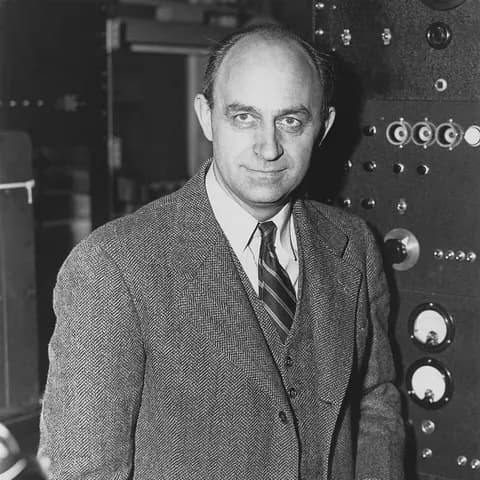 Enrico Fermi's IQPhysicist, estimated 160+160+
- Erwin Schrödinger's IQPhysicist, estimated 160160
Rankings that include Szilard
- The highest IQ scientists in historyRanked 25 of 74
Keep exploring
- Complex Problem DecompositionSign of high intelligence
- Problems Only Highly Intelligent People FaceSign of high intelligence
- L Lawliet's IQDeath Note, fan estimate 160
- Tony Stark's IQIron Man, fan estimate 160
People also search for
All 307 historical IQ estimates, ranked with ranges and sources.
Szilard's IQ is 160. What's yours?
Szilard's estimate comes from the historical record. Yours can come from a real test: 25 visual reasoning questions.
25 questions · about 12 minutes
Sources
- Leo Szilard, Encyclopaedia Britannica. Summarises his chain reaction work, the Einstein letter and later activism.
- Einstein-Szilard letter, Wikipedia. Describes the 1939 letter and its effect.
- Cox, C. M. (1926). The Early Mental Traits of Three Hundred Geniuses. Stanford University Press.
- Simonton, D. K. (2009). Genius 101. Springer.
- Cattell, R. B. (1971). Abilities: Their Structure, Growth, and Action. Houghton Mifflin.
Last reviewed October 2026. How we estimate historical IQ